
Meta title: Seattle Terminal 91 Guide for Cruise Pickups and Car Service
Meta description: Practical advice for Seattle Terminal 91 cruise pickups at Pier 91. Learn where delays happen, how pickups really work, what passengers should do, and why local experience matters.
URL slug: /blogs/seattle-terminal-91-chauffeur-guide-cruise-pickups
A lot of cruise passengers think pickup at Seattle Terminal 91 is simple. Walk off the ship, grab bags, step outside, find the car. In real life, Pier 91 can turn messy fast.
I've seen days where everything runs normally, and I've seen days where one problem changes the entire pickup plan. If you're booking Seattle cruise terminal transportation, this is what matters.
Table of Contents
Seattle Cruise Pickups Are More Complicated Than You Think

What most passengers expect
I hear the same thing from cruise passengers all the time. They expect Pier 91 to work like a hotel valet line. Walk out, spot the car, load bags, and leave in five minutes.
Some days that happens.
A lot of days, it does not. Passengers come off the ship in waves, families stop to regroup, phones die, luggage carts clog the curb, and drivers have limited room to wait without getting stuck in the wrong place at the wrong time. By the time a client says, "We're outside," they may still be ten minutes away from a pickup point that a chauffeur can reach.
That gap between what passengers picture and what the port allows is where delays start.
What Terminal 91 is really like
Smith Cove Cruise Terminal sits inside an active working waterfront. That matters because ground transportation there runs on timing and judgment, not just GPS directions and a pickup sign.
From the driver's seat, the job is part traffic management and part communication drill. Enter too early and the vehicle can get trapped in a slow queue. Arrive too late and the client is standing curbside with luggage, calling every two minutes. The best pickup is usually the one that is staged just outside the pressure point, then brought in at the right moment.
That is why local planning makes such a difference for Seattle cruise transportation. A chauffeur who works Pier 91 regularly knows when to hold outside the terminal zone, when to ask passengers for a specific door or landmark, and when a short walk saves twenty minutes in traffic.
Passengers heading into cruise season should review practical advice like these Seattle cruise season travel tips. The clients who arrive with realistic expectations usually get out faster.
The same principle applies if you're connecting a cruise transfer with an airport run or an executive airport car service. Tight handoffs leave very little room for confusion at Pier 91.
A good Pier 91 pickup comes from timing, communication, and a driver who knows how the terminal actually works.
Where Seattle Terminal 91 Pickups Actually Go Wrong
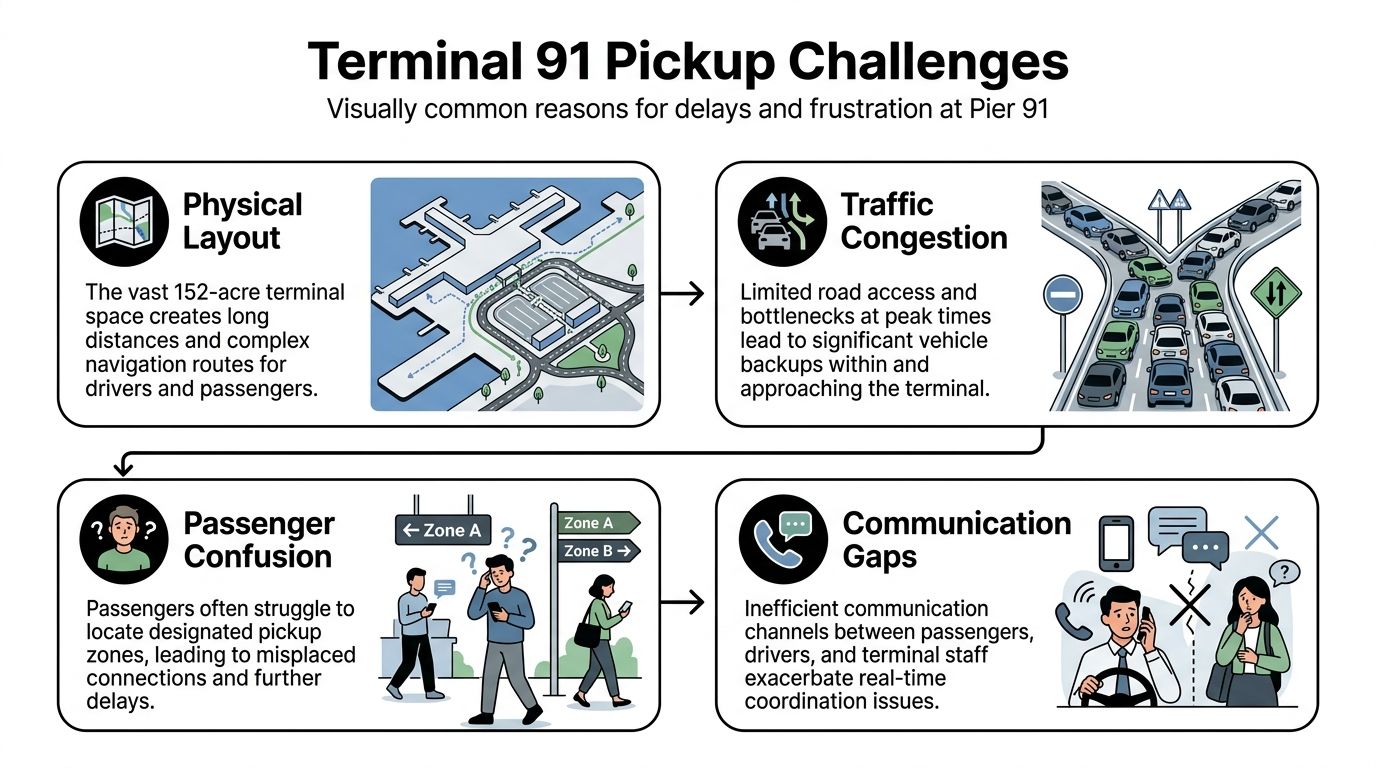
The trouble usually starts after passengers think the hard part is over.
They are off the ship, they can see daylight, and they assume pickup will work like a hotel curb. Pier 91 does not work that way. The terminal sits in a working port with controlled vehicle flow, limited curb space, and very little tolerance for hesitation. One bad assumption by the passenger or the driver can add twenty minutes fast.
A local chauffeur learns that the delay is rarely caused by one big failure. It is usually a stack of smaller mistakes. The client turns their phone back on late. One family member has the bags and another is still inside. The driver enters the terminal too soon. Traffic compresses, the curb fills, and now everyone is solving a problem that did not need to happen.
The terminal punishes bad timing
Pier 91 has room, but not the kind that helps pickups. Vehicles funnel through a controlled approach, then compete for short curb access with cruise traffic, private cars, and commercial activity around the property. Once a chauffeur commits to the wrong timing, there may be no clean way to reset.
That is why experienced Pier 91 car service operators do not treat arrival time and contact time as the same thing. A passenger can be "off the ship" and still be ten to fifteen minutes away from being ready. If the vehicle rolls in on that first text, it often ends up sitting in the worst possible place.
This is also where airport connections get risky. A cruise guest trying to make a tight flight or connect to an executive airport car service usually feels pressure to rush the handoff. Rushing creates more confusion than it saves.
Passenger behavior causes half the mess
The passenger side is less glamorous, but it is just as important. We deal with the same patterns over and over:
Phones stay silent: The chauffeur is in position, dispatch is calling, and the client is still on airplane mode or buried in the crowd.
"We are outside" means different things: Sometimes it means they are at the gangway exit. Sometimes it means one person is outside and three people are still waiting on luggage.
Meeting point guesses: The client walks to a random curb, then assumes the driver can spot them in a line of similar vehicles.
Early terminal entry by the driver: The car goes in before the passenger is settled and gets trapped in slow-moving port traffic.
The fix is simple, but passengers often skip it. Confirm bags are in hand. Turn the phone on before leaving the building. Stand at an agreed landmark, not "somewhere near the curb." If you are booking a private cruise transfer service for Pier 91, that communication discipline matters as much as the vehicle itself.
Practical rule: At Pier 91, ready means bags collected, phone on, party together, and location confirmed.
Our Pickup and Drop-Off Playbook for Pier 91
We time the approach instead of parking and hoping
The biggest mistake at seattle terminal 91 is thinking the smart move is to arrive early and sit inside the port. On many days, that does the opposite.
Our approach is simple. We stage nearby, track the flow, and move in when the client is close to pickup. That keeps the chauffeur from getting trapped in a line of private cars, shuttles, and terminal traffic with no clean exit.
For drop-offs, the process is different. The goal is to move efficiently, unload bags fast, help the client get oriented, and clear out without adding to the pileup behind the vehicle.
Here is the basic logic we follow for Smith Cove Cruise Terminal transportation:
| Situation | What works | What does not work |
|---|---|---|
| Client still inside terminal | Wait nearby and stay in contact | Entering the pickup lane too early |
| Client confirms bags in hand | Begin final approach | Guessing they will be outside soon |
| Traffic is stacked at the front | Use a cleaner timing window or alternate meeting spot | Repeating tight loops and hoping it opens |
| Drop-off with luggage | Quick unload and immediate exit | Long curbside pauses |
If someone wants a direct private transfer option built around this kind of coordination, Cruise Port Transportation is the kind of service page they should review before booking.
Communication is not optional
This is the part passengers need to hear clearly.
We can only pick you up if you are waiting there for us and we can reach you.
That means:
Keep your phone on
Watch for calls or texts
Follow the pickup instructions you were sent
Be honest about where you are
A lot of pickup failures aren't traffic failures. They're communication failures.
When clients answer quickly, the whole job gets easier. When they don't, even a strong chauffeur gets boxed into a bad setup. That's why a real cruise terminal chauffeur service depends on dispatch and passenger response just as much as the vehicle itself.
How We Handle Peak Season and Multi-Ship Days

Dispatch has to stay ahead of the problem
A busy summer Saturday at Pier 91 can go sideways before the chauffeur even reaches the terminal. Two ships may be turning at once, hotel checkouts are feeding downtown traffic, and flights are landing with late passengers who still expect a curbside pickup to work on the first pass.
Those days require a different operating plan.
Heavy cruise volume in Seattle puts real pressure on Pier 91 access, especially when ship schedules overlap and everyone wants the curb at the same time. On those days, we treat every transfer like a timed move, not a basic pickup.
That changes how we dispatch:
We add more spacing between jobs
We release cars based on live terminal conditions, not just the calendar
We keep chauffeurs and dispatch in constant contact
We prepare a backup meeting plan before the first approach fails
Passengers usually see a car that arrives at the right moment. They do not see the hold decision made ten minutes earlier, the route adjustment to avoid a clogged entrance, or the choice to keep the vehicle out of the queue until the client is reachable and ready.
That is the difference between a smooth pickup and a driver burning time in the wrong place.
For passengers who want a clearer look at how private cruise transfers are planned on high-pressure port days, these VIP Seattle cruise transfers examples give a useful look at the timing and coordination involved.
Local route planning matters
GPS will give a legal route. It will not tell you when 15th Avenue is starting to stack up, when a terminal approach is about to choke, or when waiting two extra minutes outside the port will save twenty.
That judgment comes from running these jobs over and over.
On peak days, dispatch watches three things closely. How fast vehicles are getting in and out. Whether passengers are clearing the building on schedule. How much room there is for one more clean approach before the lane turns into a trap. A bad decision at any one of those points can throw off the next several pickups.
The chauffeur matters, but on multi-ship days the primary advantage usually comes from timing and restraint. Good operators do not rush to the curb just because the reservation says the client should be out. They wait for the right window, then move with purpose.
Pier 91 rewards patience and punishes guesswork.
When It All Shuts Down A Real-World Lesson in Adaptability
The shutdown changed everything
One of the clearest examples of why cruise pickups aren't routine happened during a serious emergency at the port. A cruise passenger was struck by an SUV while he was in the middle of a cardiac arrest.
The important part from an operations standpoint was what happened next. Access changed, normal pickup flow stopped, and the entire area backed up. Nobody was running the usual plan anymore because the usual plan no longer existed.
That kind of event is rare, but the lesson is simple. If your entire pickup strategy depends on one exact curb point and no flexibility, you're in trouble the second conditions change.
What solved it
We stayed in communication with the client, adjusted the instructions, and rerouted the pickup to a nearby parking lot because the port access pattern had effectively shut down.
It took about an extra hour to reach the client because normal access stopped and traffic backed up badly. That wasn't caused by the chauffeur. It wasn't caused by the client. It was the situation on the ground.
What mattered was response:
Stay calm
Keep the client updated
Use a backup meeting point
Stop trying to force the original route
A national call-center style operation may not react well when the pickup plan falls apart in real time. A local team that knows the surrounding streets and the habits of Terminal 91 usually adjusts faster.
That day is a good reminder that Seattle cruise port pickup service isn't just about showing up with a clean vehicle. It's about thinking clearly when the port stops behaving normally.
What You Can Do For a Smoother Cruise Pickup

Do these before you step outside
Passengers have more control over the pickup than they think. A few small choices make a big difference.
Use this checklist:
Keep your phone charged and on: This is the biggest one. If your phone is dead or silenced, coordination falls apart fast.
Answer unknown local calls: Many missed pickups start with a passenger ignoring the driver's number because they don't recognize it.
Read the pickup instructions before arrival: Don't wait until you're standing outside with bags and family members asking where to go.
Be fully ready before you call: Have your luggage, your group, and your bearings.
Know your next stop: Airport, hotel, downtown meeting, or another city. That helps the driver keep the transfer moving cleanly.
For overall packing and cruise prep, this ultimate luxury cruise checklist is helpful because organized passengers usually move through disembarkation more smoothly.
Small adjustments save a lot of time
Sometimes the fastest pickup isn't directly in front of where you first stop walking.
If traffic is jammed, a short walk to a cleaner meeting point can save a lot of waiting. Not every passenger loves hearing that, but it often works better than standing in the middle of a crowded curb expecting the chauffeur to cut through blocked lanes.
A few practical reminders:
Travel with one point person: One passenger should handle the phone and talk to the chauffeur or dispatch.
Don't split the group without a plan: If part of your party is still inside, say that clearly.
Don't assume the car can wait forever at the curb: Terminal flow doesn't work that way.
If you're staying overnight, check hotel transfer options early: This guide to Seattle hotels with cruise port shuttle 2026 complete guide to Pier 66 Pier 91 helps travelers compare that part of the trip before disembarkation day.
If your chauffeur calls or texts, answer right away. A thirty-second delay can turn into a much longer pickup on a crowded port day.
Why Local Experience is Non-Negotiable for Cruise Transfers
I have watched plenty of cruise pickups fall apart with a clean sedan, a polite driver, and a customer who thought the hard part was already handled. The problem was not the vehicle. The problem was that the company treated Pier 91 like a normal address instead of a working port with cruise traffic layered onto an industrial site.
That difference shows up fast on pickup day. A driver can have the right car and still miss the job if they do not understand how terminal traffic behaves, how port access changes under pressure, or when a passenger needs to be held for a few minutes instead of sent into a clogged curb lane.
Local experience matters because cruise transfers are judged on execution, not appearance.
A Seattle operator who handles this work regularly usually brings three things that out-of-town or app-dependent services struggle with:
Judgment on timing: knowing when to stage, when to wait, and when to redirect the pickup before the curb locks up
Real route memory: knowing the surrounding streets well enough to recover when the obvious approach stops working
Tighter communication: keeping dispatch, chauffeur, and passenger on the same plan so one missed call does not turn into a missed ride
That is the part passengers rarely see online. A polished website can hide a thin operation. A company can advertise cruise service without having much real cruise-day discipline behind it. If you are comparing providers, this guide on how to verify a legitimate Seattle limo service before booking is worth reading because it shows what to check beyond pricing and vehicle photos.
I tell customers to ask simple questions. Who handles dispatch on cruise days? What happens if the terminal exit is backed up? How does the company deal with a passenger who is delayed at baggage or customs? If the answers are vague, that usually tells you enough.
All Black Limo LLC handles Port of Seattle cruise transfers, and the difference is not branding. It is local repetition. Running these pickups over and over teaches a team where the pressure points are, which calls need fast response, and which small mistakes create long delays.
Passengers do not need the fanciest ride. They need a company that knows how to finish the job when the port is messy, crowded, and running behind.
Frequently Asked Questions About Pier 91 Transportation
How early should I book Seattle cruise transportation for Pier 91?
Earlier is better, especially during cruise season and on weekends. Multi-ship days need more planning than passengers expect.
Can a chauffeur just wait at the terminal until I come out?
Not reliably. Terminal 91 flow doesn't support endless waiting at the curb. Timing has to match your actual readiness. We meet clients in front of the terminal between island 3&4.
What if my phone doesn't work when I disembark?
That creates a real problem. If possible, make sure your phone is charged and able to receive calls and texts before you leave the ship.
Can large groups use one vehicle for Smith Cove Cruise Terminal transportation?
Yes, but luggage count and group size need to be discussed in advance so the right vehicle is assigned.
What if traffic gets bad at Pier 91?
That happens. Sometimes the best solution is a short delay, a reroute, or a different nearby meeting point.
Is a local company better for Seattle port transportation?
Usually yes, because local teams know the road patterns, traffic habits, and fallback options around the port.
How much does it cost to book a transfer?
Sedan $129, MPV $159, Minibus $299 and Executive Limo $399. Book early so you can lock in price.
Need help with a Seattle Terminal 91 pickup, drop-off, airport transfer, or cruise day vehicle plan? Book with All Black Limo LLC for private Seattle cruise terminal transportation, or call 206-672-8281 to arrange your ride.